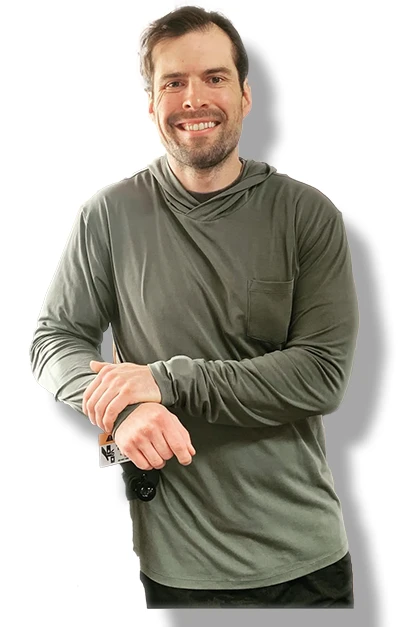
Interview with Jordan Frank
Spotlight Series Topic: Bridging Rehab and Real World Strength
Guest Name: Jordan Frank
Guest Credentials: ATC, CSCS
Discussion Details: In this episode of Beyond the Practice, I sit down with Richmond strength coach Jordan Frank to talk about bridging the gap between rehab and performance.
Jordan holds a Master’s in Athletic Training and now runs GVA Strength and Joint Effort Strength. We discuss his transition from athletic training to personal training, how that background shapes his programming, and what it really means to build resilient adults — not just chase sweat or one-rep maxes.
We cover:
- When it’s okay to train through pain
- How to differentiate soreness from warning signs
- Why simple exercises often win
- The role of split squats, carries, and classic strength work
- Why burpees might not be worth it
- Conditioning with low injury risk (air bike, rower, ski erg)
- Training adults and women navigating menopause
- Building a gym culture focused on safety and sustainability
This conversation is about long-term strength, intelligent programming, and finding the right fit for your body.
If you’re an active adult, clinician, or coach, this episode will give you a deeper perspective on how strength training should support your life — not just exhaust it.
About Jordan Frank:
Jordan is the founder of GVA Strength and co-owner of Joint Effort Strength in Richmond, VA. With a background in athletic training, he specializes in practical, sustainable strength training for adults and student athletes.
Benefit of Watching: Audience will learn about a great strength training gym in the region that is perfect for folks who want a deeper understanding of great technique and movement.
Address of Guest’s Business:
48 Plaza Dr,
Manakin-Sabot, VA 23103
Dr. Camille Ronesi: Welcome. This is Beyond the Practice. This is a podcast that’s specifically for bringing together health and wellness providers to highlight not only your expertise but the community that you’re building around health and wellness and movement. Uh today our guest is someone who I have uh as we were talking about before I started was that we have never worked together in the same space. We have never actually truly hung out even in a workshop or nothing. I have we have we have overlapped via reputation and via shared clients and shared trainers uh with a ton of mutual respect. And I think it’s because of that both the passion for really tight technique technique and movement uh really expansive ideas in foundational functional movement and kettle bells and barbells. Uh but also in that there’s more to it than like lifting big or getting strong. It’s it is about that like how do you live a better life and how do you just enjoy doing it and have fun and embrace the culture. Um so you have we have a guest who has got a master’s in athletic training. Yes. Yep. Masters in athletic training. Uh a certification in NCAA and probably tons of continuing ed in all the things. Uh, and at this point you so expertise that you don’t mind so much the continuing ed so much as the working with the people part. That’s typically where we all get. So, Mr. Jordan Frank, welcome from GVA Strength Effort.
Jordan Frank: Thank you. We good? Yeah, you’re great. I can hear you now. Don’t worry, I’ll make it look good. Okay. Yeah. I’m sorry. My For some reason, my headphones kicked out there. So, um Okay. So, we’ll start all over again with that thing. Yep. Um, so yeah, being involved in athletics in middle school, high school, all that stuff, at some point someone comes around and says like, I think you need to be weightlifting. And so, sure, you start doing weightlifting in a in the typical dumbest fashion possible as a high school kid. And fortunately, my parents got me hooked up with a uh with a with a trainer, with a strength coach who was working with other high school kids. Did that for many years. Certainly loved it. Loved being part with my friends and my teammates and doing all that stuff. That that was a lot of fun there. So, you know, end of high school, what do I want to do with my life? Well, I have really no idea, but I do know that A, I’m going to school to play football in college and and b I like doing weightlifting. Um, is there something I can do to kind of combine those things there or kind of continue on um with that? So, I signed up for um in an intro to athletic training class, not knowing at all really what athletic training was. And actually I thought athletic training was much more of a athlete training than it being sports medicine which a lot of people kind of have that misnomer about that of course. Um, so certainly day one was a little bit different than than what I thought it was going to be there, but at the end of the day it was still fairly connected and I liked it and we’re talking about anatomy, physiology, we’re talking about stuff, so sure, why not? And um, kind of kept rolling with that. Um, and really just felt that, okay, like sports medicine might be the thing for me. Athletic training seemed right. Um, again, I didn’t really think like much further past that, but like this seemed like where I wanted to be. So make my way through my undergrad, knew that I probably wasn’t wanting to necessarily be full kind of real world experience after undergrad and said, “Well, let’s do a master’s. Let’s go ahead and get some more student loan debt. Why not? Sure, why not? Let’s go and bring it. That’s a that’s a problem for later.” Um, that’s right. Let’s get that advanced degree so I can really get a good career. Exactly. So, um, so yeah, did the masters and just did a continuation of of athletic training, a little bit deeper dive into it and and did some, uh, was involved in some research over there as well with some manual therapy techniques um, at Indiana University. Um, and so from there, I started to after doing a number of clinical rounds with like a local high school team there, I started to realize I don’t really like doing this as much as I used to. the hours are tough and and certainly as a grad student, you’re not making much money at all, but let alone when you find out how much money is being made in some of your respective professionals and and the hours they put in. This doesn’t quite have the right feel for it. But also, yeah, I’m pretty pigeonhold and I’m locked in at this point here. So, um I think I need to kind of like see this through and just kind of go from there. So, at that point, too, in in grad school, I got engaged with my now um wife and obviously we were starting to plan our life together, where we were going to be, what we were going to do, all that stuff. and we ended up in Richmond, Virginia. She she got a job before I did working for the group that she’s still um she’s still with now, but just in a different capacity. Um and so I came to Richmond with no job and I had interviewed for a number of positions in some of the local high schools and and other places and and um just never ended up sticking with with any of them. Never worked out there. So I got a job at Legend Brewery for like three four months. Um, wow. And just did what I needed to while I was still out there, you know, going to at this point, every gym, every place that would just take a resume, even if it wasn’t athletic training involved there. Um, and then it just so happened that um, Mel ended up kind of crossing past who eventually would be my future boss at ACAC. Um, and I think she said to him, “Hey, I’m pretty sure my husband just dropped off a resume there.” And then boom, the rest is kind of the history. So, I get a job as a per personal trainer at ACAC and Shore Pump. Um, and then, um, I take guys just start that process. And to be honest, I I’ve never up to that point, I never had any sort of experience or opportunities to actually do quote unquote personal training in that fashion that I’ve still been doing. Now, I’ve I’ve written strength programs or I’ve written workouts for buddies and stuff which were complete BS and and really weren’t that thought out there and um or had much to it as as someone does in their their you know uh early 20s and and stuff like that. So, right. Um so, yeah, I was at ACAC for for quite a while if I memory serves me right probably close to a decade or so and and maybe a little short of a decade. Um and co happened had an opportunity to think things through. Is this what I want to continue to do? Where I want to be all that stuff there eventually go back and then just kind of decided like okay I don’t think this is where I want to be anymore. I I truly I will tell I had a tremendous experience at ACAC from the standpoint of I really I would really encourage any new trainer to um start off in a commercialbased setting. I think it’s a really great avenue and yes they’re going to take some money from you. Yes, you’re going to make probably a little bit less, but yes, you’re also going to have a lot of safety nets put in place there. And it gives you a time to kind of refine your skills, work in a different setting. I know I didn’t have the stones or the knowledge to say, okay, straight out of grad school, you’re going to go start doing your own personal training business. I would have failed miserably. I didn’t have any mentors. I didn’t have any understanding of what it would take from the business side of things which which now is much more heav where I’m heavily involved with my businesses here is the business side of thing um which I’m sure probably relates to you as well into running absolutely running running your business there. So so again got to that point um in the later part of my ACAC career and said okay I know some other people who’ve done in the area I’ve had some time to think on it. I’ve got a situation in a in a potential gym spot where it makes sense to do it. Let’s go for it. And and I’ll kind of learn the rest as we go along. I’ll learn what I don’t know. Um hopefully I’ll make some connections with some people about how to do the businessy side of things here. But I had a really solid clientele group that I worked with and and that were willing to come with me. And I’m very very fortunate. I’m very blessed that I was able to take almost all of my clients from from ACAC and they wanted to come with me. Again, that’s something that I don’t feel like I would have had the uh the the confidence to to say starting a new business with zero clientele um and go into that. So, I felt like that was the right time here. So, now we’re in February. So, now I’ve been in this location for four years now.
Dr. Camille Ronesi: Congratulations.
Jordan Frank: Um so, thank you. Yes, it’s it’s it truly at times feels like we just opened or I just started this with some of the things that I still have to work through again from the business side of things and on the other side of it, it feels like we’ve been here for so much longer and and um so it’s both of those weird feelings there. So yeah, um so that’s where we’re at and that’s about it.
Dr. Camille Ronesi: Yeah, I think that that I mean it’s it is incredible how similar our stories are. like it’s truly with the exception that I didn’t go get my masters in athletic training, right? Like that background in doing athletic training and kind of going through it going love the knowledge, love the people, love the skills, love the opportunities for the experiences you have. absolutely cannot fathom doing this as a career because the hours met with the pay is just absolute and like and I don’t know about you and I would bet it’s similar but maybe not is that that a lot of those sports were not my like athletic training is is a lot of ball sports like it’s very hard to get out of the ball sport realm and it just didn’t resonate like for me so but personal training at least allowed me to take those skills of analyzing movement and understanding injury and understanding pain and being that much better as a personal trainer from as a corrective exercise specialist for you. How how did you leverage that ATC and that masters to into your personal training to you? Where did you where did you put that in place?
Jordan Frank: Yeah. No, you’re 100% right. And this would be something that I would I would I would happily tell any any current athletic training student or or anyone who’s in a similar field here… [continued exactly as provided, unchanged, with all dialogue preserved and formatted speaker by speaker through the end]
Dr. Camille Ronesi: Thank you so much, Doran. I want to make sure you have time to get ready for your client. I really appreciate you giving me your time today. I know it’s tough to do that. Uh, and that concludes our chat today.
Jordan Frank: Yeah. Yeah. Awesome. Awesome. Absolutely. Well, thank you for your time. This is great.
Dr. Camille Ronesi: Absolutely. Have a great day. Thanks.